
In This Article
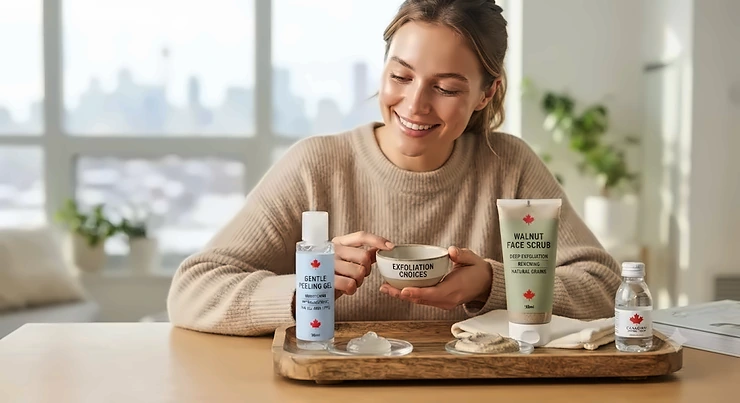
Stand in the skincare aisle of any Shoppers Drug Mart long enough and you’ll start hearing the same argument play out in whispers between friends: peeling gel or face scrub, which one do I actually start with? It’s a smaller question than “what’s my skin type,” but somehow it stalls more people at the checkout than almost anything else in the exfoliation aisle. Part of the confusion comes from the fact that both products promise the exact same outcome — smoother, brighter, less congested skin — while looking and feeling almost nothing alike in the bottle.
A face scrub is the product most of us grew up with: a cream or gel loaded with visible granules, beads, or ground particles that you massage across damp skin in small circles. A peeling gel is the newer arrival, a Korean-beauty import that goes on clear or milky, sits for a minute, and then — this is the part that either fascinates or unsettles first-time users — rolls off in little grey pills as you rub it, like an eraser working over old skin. Neither one is objectively “the beginner product.” Each has a genuinely different risk profile, a different learning curve, and a different way of going wrong if you get impatient with it.
This guide breaks the peeling gel vs face scrub for beginners decision down properly: what’s actually happening on your skin with each method, how often a first-timer should realistically use either one, the warning signs of over-exfoliation before they turn into a flare-up, and seven real products sold in Canada — three peeling gels, three scrubs, and one hybrid that splits the difference — ranked from budget to splurge. According to a foundational overview of the category on exfoliation methods, the mechanical-versus-chemical distinction between these two approaches has existed for decades; what’s changed is how gentle, and how accessible, both sides of that split have become for someone starting from zero.
Quick Comparison: Peeling Gel vs Face Scrub
Before ranking individual products, it helps to see how the two categories behave in general terms, because the differences go well beyond texture.
| Feature | Peeling Gel | Face Scrub |
|---|---|---|
| Exfoliation mechanism | Cellulose gum gel + mild enzymes/acids, light friction as it’s rubbed off | Physical friction from beads, silica, or ground particles |
| Sensation while using | Smooth “eraser” rolling motion, minimal rubbing pressure needed | Circular massaging with visible, tactile grit |
| Visible residue | Rolls into small grey pills you can see and feel | Rinses away clean, no leftover pills |
| Learning curve for beginners | Low — hard to over-scrub since there’s little friction to control | Moderate — pressure and grain size both need managing |
| Typical price range (CAD) | C$14-C$35 | C$6-C$80 |
| Best first-timer fit | Beginners nervous about visible grit or “chemical” exfoliants | Beginners who want a familiar, tactile scrubbing feel |
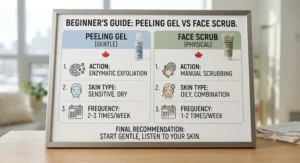
Reading this table side by side, the honest takeaway is that a peeling gel for sensitive beginners tends to remove more of the guesswork, simply because there’s very little pressure decision to make — you rub gently until the pilling stops, and that’s the whole technique. A face scrub asks a little more of you: how hard to press, how long to massage, and whether today’s grain size is too much for skin that’s already a bit reactive. Neither category is inherently superior; the peeling gel vs face scrub for beginners choice really comes down to which learning curve you’d rather climb first.
💬 Just one click — help others make better buying decisions too!😊
Top 7 Peeling Gels & Face Scrubs for Beginners: Expert Analysis
Amazon’s affiliate program requires genuine commentary, not a rewritten product listing, so every entry below gets an honest, sourced take. Three are peeling gels, three are face scrubs, and one is a premium hybrid that behaves like both — spanning budget, mid-range, and splurge pricing so there’s a sensible first purchase at nearly any comfort level.
1. Beauty of Joseon Apricot Blossom Peeling Gel — best budget peeling gel with zero acids
The Beauty of Joseon Apricot Blossom Peeling Gel is one of the most-recommended entry points into the category for a simple reason: it skips added AHA or BHA acids entirely, relying on a cellulose-gum gel base and apricot extract to do the “eraser” job without introducing an acid concentration a first-timer has to calculate. Massaged onto dry (not wet) skin for roughly a minute, it balls up and lifts dead skin cells and leftover product residue in visible little rolls, which is oddly satisfying the first time you try it and reassuring in a way scrubs aren’t — you can see exactly what’s coming off. Based on the formulation, this reads as one of the gentler ways to test whether peeling gels suit your skin at all, since the absence of acid means irritation risk is tied almost entirely to over-rubbing rather than chemical strength. Reviewers across Korean-beauty forums and retail sites consistently describe it as “the gateway peeling gel,” with a common note that it works best on makeup-free, product-free skin rather than layered over serum or sunscreen, which can gum up the rolling effect.
Pros:
- ✅ No added AHA/BHA, reducing chemical-strength guesswork
- ✅ Visible pilling makes technique easy to self-correct
- ✅ Widely regarded as the most beginner-friendly peeling gel
Cons:
- ❌ Works best on bare skin, adding a step to your routine
- ❌ Pilling can feel messy over a sink the first few tries
At around C$14-C$19 for a 100 mL bottle, Beauty of Joseon Apricot Blossom Peeling Gel is a sensible, low-risk way to try the peeling gel side of this comparison first.
2. St. Ives Fresh Skin Apricot Scrub — the classic scrub that started it all
The St. Ives Fresh Skin Apricot Scrub is arguably the most recognizable face scrub on this entire continent, and it’s worth understanding both why it became a household name and why dermatologists have spent years pushing back on it. The formula suspends ground walnut shell particles in a lightweight, oil-free base, and that grit is genuinely more aggressive than most of the other entries on this list — the particles are irregular and jagged rather than round, which is precisely the detail that drew scrutiny in a widely reported 2016 U.S. lawsuit alleging the walnut-shell texture could cause micro-tears on some skin types. What the spec sheet won’t tell you, but that controversy makes clear, is that grain shape matters more than grain size when you’re new to physical exfoliation — a rounder, softer bead is forgiving of heavy-handed technique, while a jagged one punishes it. That said, for beginners with tougher, more oil-resilient skin who use light pressure and keep sessions short, it remains an inexpensive, effective way to learn what physical exfoliation actually feels like. Aggregated reviewer sentiment splits fairly cleanly along skin type: oily and combination skin reviewers report genuine satisfaction with the texture improvement, while reactive or dry-skin reviewers more frequently mention redness afterward.
Pros:
- ✅ Extremely affordable, easy to find at any Canadian drugstore
- ✅ Noticeably improves rough texture for resilient skin types
- ✅ Familiar, tactile scrub sensation most beginners already expect
Cons:
- ❌ Jagged walnut-shell particles carry real micro-tear risk
- ❌ Too aggressive for sensitive, thin, or actively reactive skin
At roughly C$6-C$9 per tube, St. Ives Fresh Skin Apricot Scrub is cheap enough to experiment with, but it’s the one product on this list where beginners genuinely need to read the technique section below before reaching for it.
3. NEOGEN Dermalogy Bio-Peel Gauze Peeling (Lemon) — best pre-soaked 2-in-1 pads
The NEOGEN Dermalogy Bio-Peel Gauze Peeling (Lemon) solves a problem neither a jar of gel nor a tube of scrub solves on its own: consistency. Each pad is pre-soaked with a mild AHA solution featuring lemon and lemongrass extract on one side, backed by a textured gauze surface on the other, so a single swipe delivers both a light chemical exfoliation and a light physical buff without you having to measure, massage, or time anything. That dual mechanism is what makes it a genuine bridge product in the peeling gel vs face scrub for beginners debate — it isn’t purely one or the other, and for someone who can’t yet tell whether their skin prefers physical or chemical exfoliation, that ambiguity is actually useful information-gathering. Based on the concentration NEOGEN publishes for this line, the acid strength sits gentle enough for two to three uses a week even on first-timers, and the pre-portioned pad format removes the single biggest beginner mistake with liquid exfoliants: applying too much product. Reviewer sentiment on Korean-beauty retail sites consistently praises the “one-and-done” convenience and the mild citrus scent, while the most common critique is that the gauze texture side can feel slightly rough if pressed too firmly on the first few uses.
Pros:
- ✅ Pre-measured pads remove guesswork around product amount
- ✅ Combines mild chemical and physical exfoliation in one step
- ✅ Excellent for travel or low-effort routines
Cons:
- ❌ Gauze side can feel rough if used with heavy pressure
- ❌ Pricier per use than a jar-based gel or scrub
A 30-count pack runs around C$28-C$35 (smaller 8-pad trial sizes sit closer to C$10-C$14), positioning NEOGEN Dermalogy Bio-Peel Gauze Peeling as a mid-range pick for beginners who want structure built into the product itself.
4. Neutrogena Deep Clean Gentle Scrub — best fine-bead scrub for oily beginners
The Neutrogena Deep Clean Gentle Scrub exists specifically to correct the problem the previous scrub on this list illustrates: it replaces jagged natural particles with fine, rounded synthetic beads suspended in an oil-free, foaming base. That single engineering choice changes the whole risk profile — rounded beads glide rather than catch, which is why this formula is frequently recommended as the “safe” scrub for someone testing physical exfoliation for the first time. Based on the bead design, this reads as a product built to forgive imperfect technique, which matters enormously for a beginner who hasn’t yet learned to modulate pressure. It foams slightly as you massage, giving a cleansing sensation alongside the exfoliation, which most first-timers find reassuring since it feels closer to a regular face wash than a dedicated treatment. Aggregated reviews consistently describe the texture as “gentle but noticeable,” with reviewers with oily or combination skin reporting the best results; a smaller group with dry or sensitive skin still finds it slightly drying with daily use, underscoring that “gentle” scrubs still need a frequency cap.
Pros:
- ✅ Fine, rounded beads are far more forgiving than jagged grit
- ✅ Foaming action doubles as a light cleanse
- ✅ Widely available and inexpensive at Canadian drugstores
Cons:
- ❌ Oil-free base can feel drying with more than 2-3 uses weekly
- ❌ Less effective than coarser scrubs on genuinely rough texture
Priced around C$8-C$11 for a 125 mL bottle, Neutrogena Deep Clean Gentle Scrub is one of the safest possible entry points if a scrub, not a gel, is where you want to start.
5. Holika Holika Smooth Egg Skin Peeling Gel — best cult-favourite roll-off gel
The Holika Holika Smooth Egg Skin Peeling Gel has held cult status in Korean-beauty circles for years, and the egg-shaped bottle is only part of the appeal — inside is a cellulose-gum gel infused with egg extract, designed to work exactly like the Beauty of Joseon option above but with a noticeably different finish: reviewers consistently describe the “pilling” as more dramatic and visible, which some beginners find genuinely motivating (you can see the payoff) and others find slightly alarming the first time. Massaged over dry skin and rolled off within about 90 seconds, the mechanism itself is mild mechanical friction assisted by the gel’s texture rather than acid strength, so what most buyers overlook about this format is that the visible “eraser” effect is partly product residue and surface dead skin, not a sign that it’s stripping deeper layers — a distinction worth understanding before assuming more pilling automatically means more benefit. Aggregated review sentiment is strongly positive on texture improvement and the light, pleasant scent, with the most repeated critique being that results plateau if used more than the recommended two to three times weekly, since there’s simply less dead skin left to lift on the in-between days.
Pros:
- ✅ Dramatic, satisfying pilling effect beginners can visibly track
- ✅ Mild mechanism suitable for most skin types
- ✅ Long-standing cult favourite with a large review base
Cons:
- ❌ Visible pilling can be misread as “more product working harder”
- ❌ Marginal added benefit if overused beyond 2-3x weekly
At around C$14-C$19 for a 140 mL bottle, Holika Holika Smooth Egg Skin Peeling Gel is a fun, low-commitment way to compare the peeling gel experience against a scrub before settling on a routine.

6. Clinique 7 Day Scrub Cream Rinse-Off Formula — best dermatologist-developed scrub
The Clinique 7 Day Scrub Cream Rinse-Off Formula takes an entirely different engineering approach from the drugstore scrubs above: fine silica-based granules suspended in a cream (not foaming) base, allergy-tested and fragrance-free, built by a brand whose entire identity rests on dermatologist-developed formulas. The “7 Day” name is a nod to Clinique’s original three-step skin-type system, in which this scrub was meant to slot into a routine roughly twice a week rather than daily — a frequency cue baked right into the branding that beginners often miss. Based on the granule design, silica particles are engineered to be smoother and more uniformly rounded than natural exfoliants like walnut shell or even sugar, which is a meaningful part of why this has remained one of the most consistently recommended “safe” scrubs by makeup artists and skincare counters for decades. Aggregated reviewer sentiment highlights the cream base as noticeably less drying than foaming alternatives, with the most common complaint being the price relative to how quickly a jar depletes with regular use, and a smaller subset of reviewers with very reactive skin still reporting mild tingling on first use.
Pros:
- ✅ Fragrance-free, allergy-tested formula reduces irritation risk
- ✅ Cream base is gentler than foaming scrub alternatives
- ✅ Decades of dermatologist and makeup-artist recommendations
Cons:
- ❌ Premium price for a jar that depletes with regular use
- ❌ Some reactive-skin reviewers still report mild first-use tingling
Expect to pay around C$32-C$38 for a 100 mL jar — Clinique 7 Day Scrub Cream Rinse-Off Formula is a reasonable mid-to-premium pick for beginners who want a scrub with a genuinely conservative safety margin.
7. Dermalogica Daily Microfoliant — best premium hybrid powder exfoliant
The Dermalogica Daily Microfoliant doesn’t fit neatly into either the peeling gel or face scrub category, which is exactly why it earns the final spot on this list: it starts as a fine rice-based powder and activates into a creamy, foaming exfoliant the moment water touches it, combining physical texture from the rice powder with chemical exfoliation from salicylic acid (a BHA) and papain, a papaya-derived enzyme. That water-activation step is the standout feature, because it hands the beginner direct control over intensity — a small amount of water creates a thicker, more physically exfoliating paste, while more water dilutes it toward a gentler, more enzyme-forward wash. Based on the formulation, this reads as the most “graduate-level” product on this list: genuinely excellent for a beginner who’s already tested a pure peeling gel and a pure scrub and wants one product that can be dialed toward either behaviour depending on the day. Reviewers, including professional estheticians who recommend it in-treatment, consistently praise the glow it leaves and the fine, non-abrasive powder texture, while the most common critique across retail sites is simply the price relative to competing exfoliants that don’t offer the same dual mechanism.
Pros:
- ✅ Water-activation lets you control exfoliation intensity per use
- ✅ Combines physical rice-powder texture with BHA and enzyme action
- ✅ Frequently recommended by professional estheticians
Cons:
- ❌ Premium price point, the highest on this list
- ❌ Powder format has a learning curve compared to a ready gel or scrub
At around C$74-C$80 for a 2.6 oz (74 g) jar, Dermalogica Daily Microfoliant is the splurge pick for beginners who want one product to eventually replace both a dedicated peeling gel and a dedicated scrub.
Top 7 Products at a Glance
| # | Product | Category | Mechanism | Price Range (CAD) | Best For |
|---|---|---|---|---|---|
| 1 | Beauty of Joseon Apricot Blossom Peeling Gel | Peeling gel | Cellulose gel, no added acid | C$14-C$19 | Acid-nervous first-timers |
| 2 | St. Ives Fresh Skin Apricot Scrub | Face scrub | Ground walnut shell | C$6-C$9 | Resilient, oily/combo skin |
| 3 | NEOGEN Dermalogy Bio-Peel Gauze Peeling | Hybrid pad | Mild AHA + textured gauze | C$28-C$35 | Structured, low-effort routines |
| 4 | Neutrogena Deep Clean Gentle Scrub | Face scrub | Fine rounded beads | C$8-C$11 | Oily/combo beginners |
| 5 | Holika Holika Smooth Egg Skin Peeling Gel | Peeling gel | Cellulose gel, mild friction | C$14-C$19 | Visible, motivating results |
| 6 | Clinique 7 Day Scrub Cream Rinse-Off Formula | Face scrub | Fine silica granules | C$32-C$38 | Sensitive, cautious starters |
| 7 | Dermalogica Daily Microfoliant | Hybrid powder | Rice powder + BHA + enzyme | C$74-C$80 | Beginners ready to level up |
Looking at the table as a whole, the peeling gel vs face scrub for beginners split isn’t really about which category is “better” — it’s about matching the mechanism to how much control you want over your own technique. The three peeling gels (Beauty of Joseon Apricot Blossom Peeling Gel, Holika Holika Smooth Egg Skin Peeling Gel, and the hybrid NEOGEN Dermalogy Bio-Peel Gauze Peeling) all remove some portion of the pressure-judgment call from your hands, while the three scrubs (St. Ives Fresh Skin Apricot Scrub, Neutrogena Deep Clean Gentle Scrub, and Clinique 7 Day Scrub Cream Rinse-Off Formula) ask more of your technique but reward you with a familiar, tactile ritual. The Dermalogica Daily Microfoliant sits above both, worth considering once you already know which mechanism your skin tolerates better.
What Is a Peeling Gel? What Is a Face Scrub?
A peeling gel is a cellulose-gum-based gel, usually acid-light or acid-free, that’s massaged onto dry skin and rolled off in small pills, lifting dead skin cells through a combination of mild friction and the gel’s own texture rather than visible grit. A face scrub is a cream, gel, or foaming base loaded with physical particles — beads, silica, sugar, or ground shells — that are massaged directly against skin to mechanically dislodge dead cells through friction you can both see and feel.
That’s the entire distinction in a sentence, but the practical difference runs deeper once you’re actually standing at the sink. A peeling gel’s exfoliation happens largely through the gel itself catching on dead, loosely-attached skin cells as it balls up — your hands provide motion, not pressure. A face scrub’s exfoliation is a direct function of how hard you press and how coarse the particles are, which is precisely why scrubs carry a wider gap between “gentle” and “harsh” versions of the same product category, as the St. Ives Fresh Skin Apricot Scrub and Neutrogena Deep Clean Gentle Scrub comparison above makes clear.
Peeling Gel vs Face Scrub: How Each Actually Works on Skin
Peeling gels and face scrubs both aim to remove the same outermost layer of dead cells, but the mechanism behind each changes what happens beneath the surface. A peeling gel like Beauty of Joseon Apricot Blossom Peeling Gel relies on the cellulose gum forming a thin film that grips loosely-attached dead cells and product residue as it’s rubbed; because there’s minimal downward pressure involved, the friction stays largely at the very surface, which is part of why over-exfoliation is harder (though not impossible) to achieve with this category. A face scrub like St. Ives Fresh Skin Apricot Scrub works through direct abrasion — the particles physically knock cells loose as they’re dragged across skin, and that same mechanism is what delivers a faster, more dramatic smoothness after a single use, at the cost of a narrower safety margin if the particles are jagged or the pressure is heavy.
The honest, non-marketing answer to which mechanism is “better” is that they solve slightly different problems. Peeling gels excel at lifting surface flakiness and dulling residue with low technique risk, which is exactly why they dominate recommendations for a gentle first exfoliator Canada beginners are searching for. Scrubs excel at resurfacing genuinely rough or congested texture faster, provided the particle shape and your pressure are both dialed in correctly. Dermatologists frequently note, as covered in a peer-reviewed review of hydroxy acids on skin, that gentler, more surface-level exfoliation methods tend to carry a better long-term risk-to-benefit ratio for skin that hasn’t yet built tolerance — which tilts the beginner calculus toward peeling gels and fine-bead scrubs over coarser, jagged alternatives.
The Easiest Exfoliation Method for Beginners
If the goal is simply the easiest exfoliation method for beginners to get right on the first try, peeling gels have a real structural advantage: the technique is nearly foolproof. Apply to dry skin, rub in small circles, stop when the pilling stops — there’s no grain size to misjudge and very little pressure required, which removes the two variables most likely to cause a beginner’s first bad exfoliation experience. Products like Beauty of Joseon Apricot Blossom Peeling Gel and Holika Holika Smooth Egg Skin Peeling Gel both lean into this simplicity, and the visible pilling doubles as real-time feedback: once nothing more comes off, you’re done, which is a built-in stopping cue that scrubs simply don’t offer.
Face scrubs can be nearly as easy, but only the fine-bead versions. Neutrogena Deep Clean Gentle Scrub‘s rounded particles and Clinique 7 Day Scrub Cream Rinse-Off Formula‘s uniform silica granules both remove most of the risk that comes with jagged, irregular grit, though you still need to consciously use light pressure and a short massage time — a judgment call peeling gels largely sidestep. For an absolute first-timer choosing between the two mechanisms with no prior exfoliation experience at all, a peeling gel is the lower-risk starting point purely because it asks less of your technique.
Gentle First Exfoliator: What Canadian Beginners Should Look For
Finding a genuinely gentle first exfoliator Canada shoppers can trust comes down to reading past the marketing language on the front of the bottle and checking three things instead. First, particle shape and size for scrubs — rounded, fine, and uniform (as in Neutrogena Deep Clean Gentle Scrub) beats jagged and irregular (as in the harsher end of St. Ives Fresh Skin Apricot Scrub‘s particle range) every time for first-time use. Second, acid concentration for any gel or pad that includes chemical exfoliants — Health Canada’s Cosmetic Ingredient Hotlist sets restrictions on which acids and at what concentrations can be sold in leave-on and rinse-off cosmetics in Canada, so anything legally sold here has already cleared a baseline safety threshold, though “legal” and “beginner-appropriate” aren’t the same standard. Third, fragrance load — fragrance-free or lightly scented formulas, like Clinique 7 Day Scrub Cream Rinse-Off Formula, reduce one whole category of possible irritation while you’re still learning how your skin reacts to exfoliation itself.
Climate matters too. Canadian winters strip humidity indoors and out, which means a gentle first exfoliator needs to pair naturally with a moisturizing step immediately after, not just be mild in isolation — a detail covered in more depth in the routine-building section below.
How to Choose Between Peeling Gel and Face Scrub
- Assess your current skin sensitivity honestly. Active redness, breakouts, or recently used retinoids or acids point toward a peeling gel or the gentlest fine-bead scrub, not a coarse option.
- Consider how much you trust your own pressure control. If you tend to scrub hard out of habit, a peeling gel like Beauty of Joseon Apricot Blossom Peeling Gel removes that risk almost entirely.
- Think about texture preference, not just results. Some people genuinely dislike the pilling sensation of a peeling gel; if that’s you, a fine-bead scrub like Neutrogena Deep Clean Gentle Scrub delivers similar gentleness without it.
- Factor in your skin type. Oily and combination skin generally tolerates scrubs like St. Ives Fresh Skin Apricot Scrub better; dry or reactive skin usually does better starting with a gel.
- Check whether you want a bridge product. A hybrid like NEOGEN Dermalogy Bio-Peel Gauze Peeling lets you sample both mechanisms in one pad before committing to a dedicated routine.
- Set a realistic frequency from day one. Whichever you pick, plan for two to three uses weekly, not daily — more on why in the frequency section below.
- Budget for the moisturizer that follows. No exfoliant, gel or scrub, should be the last step; a barrier-supporting moisturizer applied right after closes the loop properly.
✨ Ready to compare picks side by side? Check current prices on the seven products above before you commit to your first exfoliator.
Building a Beginner Skincare Routine Around Exfoliation
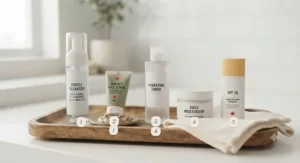
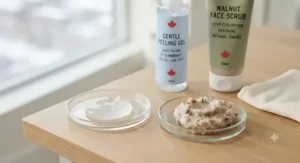
A beginner skincare routine built around exfoliation works best when the exfoliating step is treated as an occasional guest star, not a daily headliner. On exfoliation days, the order runs: gentle cleanser first, to remove surface oil and makeup so the peeling gel or scrub can actually reach dead skin cells rather than sliding over a layer of product; the exfoliant itself, applied per the product’s specific instructions (dry skin for peeling gels, damp skin for most scrubs); a thorough lukewarm rinse; then immediately, a fragrance-light moisturizer while skin is still slightly damp, followed by sunscreen if it’s daytime, since freshly exfoliated skin is measurably more sensitive to UV exposure for the following 24 to 48 hours. On non-exfoliation days, the routine simplifies to cleanser, moisturizer, and sunscreen — no gel, no scrub, no exception, even if skin looks a little dull that morning.
The single most common beginner mistake in building this routine is layering a new exfoliant into a skincare stack that already includes a retinoid, vitamin C serum, or another active ingredient, without spacing them out. For the first month with any new peeling gel or scrub, keep the rest of the routine deliberately simple — a basic cleanser and moisturizer — so that if irritation shows up, there’s exactly one new variable to blame.
Real-World Scenarios: Matching the Right Exfoliator to Your Skin
Consider three different beginners and how the peeling gel vs face scrub for beginners decision actually plays out for each. A university student in Kingston with oily, breakout-prone skin and a tight budget is well served by Neutrogena Deep Clean Gentle Scrub or St. Ives Fresh Skin Apricot Scrub used twice weekly — both are inexpensive enough to experiment with, and resilient oily skin tends to tolerate the physical friction better than dry or reactive skin does. A remote worker in Calgary dealing with dry, tight, winter-stressed skin and zero prior exfoliation experience is better matched to Beauty of Joseon Apricot Blossom Peeling Gel, since the acid-free formula and low-pressure technique minimize the two biggest risk factors for already-compromised skin. A skincare-curious beginner in Toronto who’s watched enough videos to be intrigued but nervous about “doing it wrong” fits the NEOGEN Dermalogy Bio-Peel Gauze Peeling profile best — the pre-measured, single-use pad format removes nearly every decision point, making it close to impossible to overdo in a single session.
None of these profiles are guesses; they map to the same core variables — skin type, sensitivity level, and comfort with technique — that any dermatologist would ask about before recommending a starting product, which is exactly the logic behind the Canadian Dermatology Association’s recognized skincare product guidance.
Peeling Gel for Sensitive Beginners: What to Check First
A peeling gel for sensitive beginners still needs vetting before it earns “gentle” status, because not every peeling gel on the market is acid-free the way Beauty of Joseon Apricot Blossom Peeling Gel is. Some peeling gels lean on AHA or BHA concentrations for their exfoliating power rather than pure mechanical rolling, and those formulas behave much closer to a chemical exfoliant than a physical one — worth checking the ingredient list for glycolic, lactic, or salicylic acid before assuming any peeling gel is automatically the gentle option. For genuinely reactive, eczema-prone, or rosacea-affected skin, the safest starting point is a cellulose-gum peeling gel with no added acid, used once weekly rather than the standard two to three times, with a full week of plain moisturizing between sessions if any redness shows up.
Patch-testing matters more here than with almost any other product category on this list. Apply a small amount to the inner forearm, wait 24 hours, and only move to the face if there’s no reaction — a step that takes one extra day and prevents a genuinely uncomfortable first face-exfoliation experience.
Exfoliation Frequency: How Often Should Beginners Actually Exfoliate?
The honest answer to exfoliation frequency for beginners is two to three times per week, starting even lower — once weekly — for the first two to three weeks with any new peeling gel or scrub, regardless of how gentle the label claims to be. Dead skin cell turnover simply doesn’t happen fast enough to justify daily exfoliation; the skin’s natural renewal cycle runs roughly three to four weeks in healthy adult skin, which means exfoliating more often than every other day isn’t accelerating anything, it’s just adding irritation risk without proportional benefit.
A practical way to think about frequency: start at once weekly for weeks one and two, watching for any redness, tightness, or stinging that lasts more than an hour after rinsing. If skin tolerates that without issue, move to twice weekly for weeks three and four. Only after a full month of clean tolerance should beginners consider three times weekly, and even then, that ceiling should hold regardless of which product from this list you’re using — peeling gel, scrub, or the hybrid Dermalogica Daily Microfoliant.
Over-Exfoliation Risk: Warning Signs and the Problem-Solution Fix
Over-exfoliation risk is the single biggest reason beginners abandon exfoliation altogether, usually because the warning signs get misread as “not enough” rather than “too much.” Persistent redness lasting more than an hour after rinsing, a tight or stinging sensation that shows up with products that previously felt fine, visible flaking that worsens rather than improves over a week, and a shiny, overly reflective look to skin (a sign the barrier itself is compromised, not just dead skin removed) are the four clearest signals to stop immediately.
Problem: skin feels raw or stings after every exfoliation session. Solution: pause all exfoliation for seven to ten days, moisturize only, then reintroduce at half the previous frequency with the gentlest product on this list, Beauty of Joseon Apricot Blossom Peeling Gel.
Problem: breakouts increased after starting a new scrub. Solution: switch from a coarse scrub like St. Ives Fresh Skin Apricot Scrub to a fine-bead option like Neutrogena Deep Clean Gentle Scrub, since jagged particles can spread bacteria across active breakouts rather than clearing them.
Problem: skin looks shiny and feels tight, not smooth. Solution: this is barrier damage, not success — stop exfoliating entirely for one to two weeks and focus purely on a barrier-repairing moisturizer before any product on this list re-enters the routine.
Problem: no visible improvement after a month of consistent use. Solution: reassess the mechanism, not the frequency — a beginner using a mild peeling gel with genuinely rough, congested texture may need the stronger physical action of a scrub instead, or vice versa.
Common Mistakes Beginners Make With Peeling Gels and Scrubs
The most frequent mistake is treating “gentle” as a license for daily use — even the mildest product on this list, Beauty of Joseon Apricot Blossom Peeling Gel, benefits from a frequency cap, and no amount of gentleness makes daily exfoliation appropriate for beginner skin. A second common error is applying a peeling gel over serum, sunscreen, or makeup residue instead of clean, dry skin, which prevents the gel from properly gripping dead cells and often gets misread as “the product not working.” Beginners also frequently skip the patch test entirely, especially with peeling gels that include acids, assuming the word “gel” implies automatic gentleness. Finally, one of the most damaging mistakes is combining a fresh exfoliation session with a strong active ingredient — retinoid, vitamin C, or a separate acid toner — on the same evening; spacing actives across different nights is a simple habit that prevents most beginner irritation before it starts.
Long-Term Cost & Maintenance: Peeling Gel vs Face Scrub
| Product | Typical Size | Uses Per Container (approx.) | Annual Cost Estimate (CAD)* |
|---|---|---|---|
| Beauty of Joseon Apricot Blossom Peeling Gel | 100 mL | ~50 uses | C$40-C$55 |
| St. Ives Fresh Skin Apricot Scrub | 170 g | ~60 uses | C$20-C$30 |
| NEOGEN Dermalogy Bio-Peel Gauze Peeling | 30 pads | 30 uses | C$65-C$90 |
| Neutrogena Deep Clean Gentle Scrub | 125 mL | ~55 uses | C$25-C$35 |
| Holika Holika Smooth Egg Skin Peeling Gel | 140 mL | ~50 uses | C$40-C$55 |
| Clinique 7 Day Scrub Cream Rinse-Off Formula | 100 mL | ~55 uses | C$85-C$105 |
| Dermalogica Daily Microfoliant | 74 g | ~90 uses | C$90-C$110 |
*Estimated at roughly twice-weekly use over a year; actual cost varies with technique and how much product each application uses.
Cost-per-use tells a more honest story than sticker price here. The NEOGEN Dermalogy Bio-Peel Gauze Peeling pads look mid-range on the shelf but land among the pricier options annually once you account for their single-use format, while St. Ives Fresh Skin Apricot Scrub and Neutrogena Deep Clean Gentle Scrub remain the cheapest ways to build the habit over a full year. The Dermalogica Daily Microfoliant justifies its steep upfront price partly through efficiency — the water-activated powder format means a little goes a long way, narrowing the annual gap with mid-range options more than the sticker price initially suggests.
Features That Actually Matter (And Marketing Hype to Ignore)
Marketing copy for both peeling gels and face scrubs loves to lean on words like “micro-exfoliating,” “resurfacing,” and “cell renewal,” but only a handful of features genuinely change the beginner experience. Particle shape matters more than particle count for scrubs — rounded and uniform beats jagged and irregular every single time, which is the entire practical difference between St. Ives Fresh Skin Apricot Scrub and Neutrogena Deep Clean Gentle Scrub. For peeling gels, whether the formula includes added acid matters more than the brand’s marketing language around “deep cleansing,” since an acid-free gel like Beauty of Joseon Apricot Blossom Peeling Gel behaves fundamentally differently on skin than an acid-boosted one. Fragrance load is worth checking regardless of category — fragrance-free formulas like Clinique 7 Day Scrub Cream Rinse-Off Formula remove a whole variable while you’re still learning your skin’s tolerance. What doesn’t matter nearly as much as the label suggests: exotic-sounding botanical extracts, “detox” claims, and gold or charcoal additives, none of which meaningfully change the underlying exfoliation mechanism a beginner actually needs to understand.
Frequently Asked Questions
❓ Is peeling gel or face scrub better for beginners?
❓ How often should a beginner use a peeling gel or face scrub?
❓ Can peeling gel damage sensitive skin?
❓ What are the signs of over-exfoliation?
❓ Should I use a face scrub every day to see faster results?
Conclusion
The honest answer to peeling gel vs face scrub for beginners isn’t that one method wins outright — it’s that peeling gels generally ask less of your technique, while fine-bead scrubs offer a more familiar, tactile ritual that resilient skin tolerates well. Among the seven products covered here, Beauty of Joseon Apricot Blossom Peeling Gel stands out as the lowest-risk true first purchase, Neutrogena Deep Clean Gentle Scrub and Clinique 7 Day Scrub Cream Rinse-Off Formula offer the gentlest scrub-side entry points, and Dermalogica Daily Microfoliant is worth graduating to once you already know which mechanism your skin prefers.
Whichever category you start with, the two habits that matter more than any single product choice are capping frequency at two to three times weekly and following every session with a proper moisturizer while skin is still damp. Get those two things right, and the peeling gel vs face scrub for beginners debate stops being a source of anxiety and becomes what it should have been from the start: a genuinely low-stakes first step into a smarter skincare routine.
✨ Don’t Miss These Exclusive Deals! 🔍
Take your beginner skincare routine to the next level with these carefully selected peeling gels and face scrubs. Click on any highlighted product to check current pricing and availability. These picks will help you build a gentler, more confident exfoliation routine your skin will genuinely thank you for!
Recommended for You
- AHA vs BHA Exfoliator For Acne-Prone Skin: 7 Picks (2026)
- 7 Best Enzyme Exfoliators for Sensitive Skin in Canada (2026)
- Physical Exfoliator for Dry Skin: 7 Best Picks for Canada (2026)
Disclaimer: This article contains affiliate links. As an Amazon Associate, I earn from qualifying purchases. If you purchase products through these links, we may earn a small commission at no additional cost to you.
✨ Found this helpful? Share it with your friends! 💬🤗
