In This Article
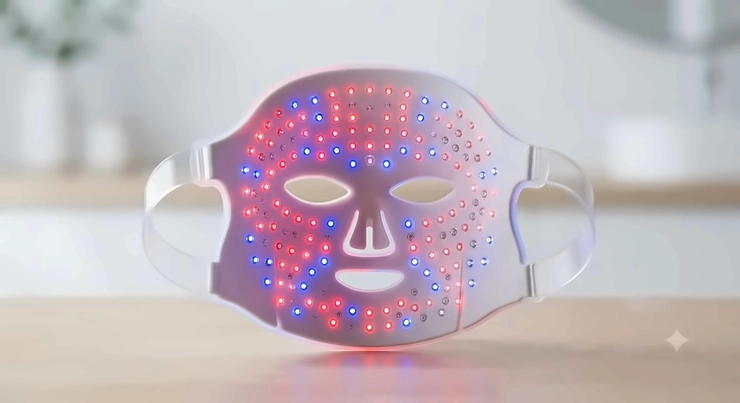
Picture a Canadian February. The sun sets around 5 p.m., the furnace has been running since Thanksgiving, and your skin looks about as lively as a parking-lot snowbank. That’s roughly when a lot of people start eyeing an LED light therapy mask — the glowing, slightly sci-fi device that went from dermatology clinics to Instagram feeds to bathroom counters in about five years.

Here’s the thing, though. An LED light therapy mask is not magic, and it’s not a gimmick either. It sits in that interesting middle ground where the science is real but modest, the results are gradual, and the difference between a good device and a dud comes down to a handful of specs most listings bury — wavelength, LED density, fit, and whether the thing is actually licensed to be sold here.
So I did the homework. This guide pulls together published specs, regulatory status, clinical literature, and the broad themes that show up again and again in real user reviews for seven masks you can find on amazon.ca in 2026. You’ll get the budget pick that punches above its weight, the premium options with serious clinical backing, and the acne-focused devices that lean on blue light instead of red.
We’ll also cover the questions that actually decide whether you’ll be happy in twelve weeks: red vs blue light, whether one LED mask for acne and aging can really do both jobs, how light therapy stacks up against other at-home skincare devices, and what Health Canada licensing means for you as a buyer.
No hype, no invented testimonials — just the analysis you need to spend a few hundred dollars wisely. ✨
What Is an LED Light Therapy Mask?
An LED light therapy mask is a wearable device lined with light-emitting diodes that shine specific, non-UV wavelengths — usually red (around 630-660 nm), near-infrared (around 830-850 nm), and blue (around 415 nm) — onto the skin for short sessions. Red and infrared target signs of aging; blue targets acne-causing bacteria.
That’s the snippet version. The longer version is that the technique belongs to a broader family of treatments known as light therapy, sometimes called photobiomodulation when it’s used on skin and tissue. Unlike tanning beds or the UV phototherapy dermatologists use for psoriasis, LED masks don’t use ultraviolet light, so they don’t tan or burn you.
How the colours work (in plain English)
- 🔴 Red light (≈630-660 nm): Reaches the upper dermis. The leading theory is that it nudges mitochondria in skin cells to produce more energy, which in turn supports collagen production and calms inflammation.
- 🌡️ Near-infrared (≈830-1072 nm): Invisible to the eye, it travels deeper than red. It’s the colour most associated with firmness and recovery.
- 🔵 Blue light (≈415 nm): Stays near the surface, where it reacts with porphyrins produced by C. acnes bacteria. That reaction is why blue is the go-to colour for breakouts.
What it won’t do
It won’t replace a retinoid, erase deep wrinkles, or rescue skin from a zero-SPF lifestyle. Think of it as a slow, steady supporting actor — the kind that makes the lead (your core routine) look better over months, not overnight.
Quick Comparison Table
| Mask | Light Colours | LEDs | Session | Approx. Price (CAD) | Best For |
|---|---|---|---|---|---|
| CurrentBody Skin LED Mask Series 2 | Red, NIR, deep NIR | 236 | 10 min | C$600-C$700 | Mature skin, fine lines |
| Omnilux Contour Face | Red, NIR | 132 | 10 min | Mid-C$500s | Clinically backed anti-aging |
| Dr. Dennis Gross DRx SpectraLite FaceWare Pro | Red, blue | 162 | 3 min | C$600-C$700 | Busy people with acne + aging |
| Shark CryoGlow | Red, blue, NIR | 160 | 4-8 min | Around C$500 | Puffy eyes + breakouts |
| Therabody TheraFace Mask Glo | Red, blue, NIR | 504 | 4-12 min | C$500-C$600 | High LED density, cordless |
| Kandyway Red Light Therapy Mask | Red, NIR | 132 | ~10 min | C$400-C$550 | Health Canada–licensed pick |
| RENPHO Artemis LED Mask | Red, blue, NIR | 324 | 10/20/30 min | C$200-C$300 | Best budget value |
Reading across that table, the first thing to notice is that LED count and price don’t move in lockstep — the RENPHO Artemis LED Mask packs more diodes than the CurrentBody Skin LED Mask Series 2 for roughly a third of the price, yet it doesn’t have the same depth of published clinical data. Meanwhile, the Dr. Dennis Gross DRx SpectraLite FaceWare Pro wins on convenience with 3-minute sessions, which matters more than most spec sheets admit. If you’re mostly fighting fine lines, a red/near-infrared mask is enough; if breakouts are the headline problem, prioritise one with blue light.
💬 Just one click — help others make better buying decisions too!😊
Top 7 LED Light Therapy Masks: Expert Analysis
Every product below is available to Canadian shoppers on amazon.ca at the time of research. Prices move constantly, so treat the ranges as a guide and check current pricing before you buy.
1. CurrentBody Skin LED Mask Series 2 — deepest wavelength stack in its class
The CurrentBody Skin LED Mask Series 2 is the only mask here that adds a third, deep near-infrared wavelength at 1072 nm on top of the standard 633 nm red and 830 nm near-infrared.
On paper, its 236 LEDs in flexible liquid silicone translate into better coverage and fewer “dead zones” around the jawline and cheeks than rigid shells. The 10-minute session and roughly 12 sessions per charge mean you’re plugging it in about every two to three weeks at the recommended 3-5 sessions per week. The trade-off: a lengthy 4.5-hour charge and exactly one program — no settings, no blue light.
Here’s what to weigh. This is a mask built for one job — anti-aging — and it does that job with the strongest published marketing claims in the category (the brand cites a 30% wrinkle reduction over eight weeks in its own study). If acne isn’t on your radar and you want the most thoroughly engineered red light therapy face mask, it’s the benchmark others get measured against.
Reviewers consistently praise the soft, flexible fit and a noticeable glow after a few weeks of steady use; the most common grumbles concern the single mode and the strap assembly.
Pros:
- ✅ Three wavelengths including rare 1072 nm deep NIR
- ✅ Flexible silicone hugs varied face shapes
- ✅ Two-year warranty and FDA clearance
Cons:
- ❌ No blue light for acne
- ❌ Slow 4.5-hour recharge
Expect to see it in the C$600-C$700 range (check current price) — a premium, but defensible if you’ll use it for years.
2. Omnilux Contour Face — the clinic brand gone cordless
The Omnilux Contour Face comes from a company whose LED panels have lived in dermatology clinics for years, and that heritage is its biggest selling point.
It uses 132 LEDs at 633 nm red and 830 nm near-infrared — the same two-wavelength combination that underpins much of the published research on red light for skin. The 10-minute session, 3-5 times a week, is standard. What that means in practice: you’re not buying novelty, you’re buying the well-trodden path that most of the evidence actually studied.
Based on the spec comparison, the Omnilux Contour Face has fewer LEDs than the CurrentBody Skin LED Mask Series 2, but LED count alone is a blunt instrument; irradiance and consistent contact matter just as much. Its flexible silicone body sits closely on the skin and stores flat in a drawer, which is handy if your bathroom counter is already crowded.
The broad theme in user reviews is gradual improvement — smoother texture in the first couple of weeks, softer fine lines by weeks three to six — paired with reminders that skipping sessions stalls progress. A recurring complaint is that eye protection isn’t included in every bundle.
Pros:
- ✅ Strong clinical pedigree and FDA clearance
- ✅ Lightweight, flexible, flat-storing design
- ✅ Proven red/NIR wavelength pairing
Cons:
- ❌ Eye goggles not always included
- ❌ No acne-targeting blue light
It typically lands in the mid-C$500s — fair value for buyers who trust clinical heritage over LED head-counts.
3. Dr. Dennis Gross DRx SpectraLite FaceWare Pro — fastest sessions for acne and aging
The Dr. Dennis Gross DRx SpectraLite FaceWare Pro is the time-poor person’s mask: a full treatment takes just three minutes.
It combines 100 red LEDs at 630 nm with roughly 60 blue LEDs at 415 nm, for 162 total. That red/blue pairing means you can run anti-aging, anti-acne, or combined modes — making it one of the few devices that genuinely qualifies as an LED mask for acne and aging in a single shell. The catch is that it skips near-infrared entirely and uses a corded controller.
What most buyers overlook is fit. The rigid white shell looks iconic but doesn’t flex, so on narrower or wider faces some reviewers note small gaps where light doesn’t sit flush against the skin. If your face shape suits it, though, the three-minute routine is so short you’ll actually do it daily — and consistency beats raw power every time.
Aggregated review sentiment leans positive on convenience and on blue-light results for mild breakouts, while negative reviews centre on the stiff fit, the cord, and the premium price.
Pros:
- ✅ Three-minute sessions boost daily consistency
- ✅ Red and blue modes in one device
- ✅ FDA-cleared, dermatologist-founded brand
Cons:
- ❌ Rigid shell may leave light gaps
- ❌ No near-infrared wavelength
Plan on roughly C$600-C$700 (prices may vary) — worth it mainly if speed is your deal-breaker.
4. Shark CryoGlow — the only one that chills your under-eyes
The Shark CryoGlow brings something no competitor here offers: InstaChill cooling pads that sit under your eyes during every treatment.
It uses 160 LEDs across red, blue, and near-infrared light and runs four programs — Better Aging, Blemish Repair, Skin Sustain, and Under-Eye Revive — with sessions between 4 and 8 minutes. At about 680 g (1.5 lb) with a hard shell, it’s heavier and bulkier than silicone masks, but it charges via USB-C and lasts roughly a week between charges with regular use.
Here’s the honest analysis: the cooling pads are a genuine differentiator for puffiness, but they also physically block LED light from reaching the under-eye area. So you’re trading light exposure on that zone for de-puffing. For people whose main morning complaint is “I look tired,” that’s a smart trade. For people targeting crow’s feet specifically, maybe not.
Reviewers frequently call the cooling feature the highlight and appreciate the controller’s progress display, while complaints mention a low whirring noise and awkward storage.
Pros:
- ✅ Under-eye cooling tackles morning puffiness
- ✅ Four programs covering acne and aging
- ✅ Short 4-8 minute sessions
Cons:
- ❌ Bulky, rigid shell is heavier
- ❌ Cooling pads block light under eyes
Expect around C$500 — solid value if puffiness is a daily battle.
5. Therabody TheraFace Mask Glo — LED density champion, fully cordless
The Therabody TheraFace Mask Glo is built around sheer density: 504 LEDs, the highest count in this lineup.
It offers blue (415 nm), red (633 nm), and red-plus-infrared (633 nm and 830 nm) modes, with a standard 12-minute program and shorter 4-12 minute options. At about 514 g, it’s cordless with USB-C charging and roughly 60 minutes of run time per charge. In practical terms, that’s around five full sessions before you need the cable — fine for most weeks, but you’ll charge it more often than the CurrentBody Skin LED Mask Series 2.
Why does density matter? More LEDs spread across the shell means more even coverage, including around the eyes and mouth where lower-density masks leave gaps. For anyone who wants both acne and aging modes without a cord, it’s the most complete package on paper.
Real-world review themes praise the hands-free, cordless freedom and the even glow, while the most common drawbacks involve the rigid frame’s weight on the nose and the short battery window.
Pros:
- ✅ 504 LEDs for exceptionally even coverage
- ✅ Blue, red, and NIR modes
- ✅ Truly cordless, hands-free design
Cons:
- ❌ Short roughly 60-minute battery
- ❌ Rigid frame can press on nose
Usually in the C$500-C$600 range (check current price) — strong value for a do-it-all cordless mask.
6. Kandyway Red Light Therapy Mask — Health Canada–licensed and medical-grade
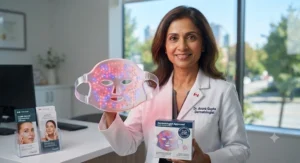
The Kandyway Red Light Therapy Mask carries one credential most Amazon listings can’t: it’s marketed as Health Canada authorized as well as FDA-cleared.
Its spec sheet is refreshingly specific: 132 LEDs (66 bulbs with two diodes each) at 633 nm ±10 nm red and 830 nm ±17.5 nm near-infrared, with a stated energy output of about 35 mW/cm². That published irradiance number is rare — most brands never tell you how much light actually reaches your skin, which makes comparisons guesswork. At roughly 600 g including the controller, it isn’t light, but the flexible silicone mask spreads the weight.
For Canadian buyers, licensing is the headline. You can verify a device’s status yourself on Health Canada’s Medical Devices Active Licence Listing, which is more reassurance than you’ll get from most no-name alternatives. Warranty support — two years on the mask, one on the controller — adds to that peace of mind.
Review sentiment we could find generally highlights comfort and the regulatory credentials; some buyers note the controller adds bulk and that results take several weeks to appear. We couldn’t independently verify a large, detailed body of reviews, so treat that sentiment as indicative.
Pros:
- ✅ Health Canada authorized and FDA-cleared
- ✅ Published irradiance of ~35 mW/cm²
- ✅ Two-year mask warranty
Cons:
- ❌ Heavier with controller attached
- ❌ No blue light for breakouts
Typically C$400-C$550 (prices may vary) — excellent value for licence-conscious Canadians.
7. RENPHO Artemis LED Mask — best budget all-rounder
The RENPHO Artemis LED Mask proves you don’t need to spend C$600 to get red, blue, and near-infrared in one soft mask.
It packs 324 LEDs into a flexible silicone body with three modes — red + NIR for firming, blue + NIR for breakouts, and a combo mode — plus five intensity levels and auto-shutoff at 10, 20, or 30 minutes. The wired controller lasts roughly a month per charge with daily use. The brand markets it as a Class II medical device and backs it with a two-year warranty and 30-day return window.
Here’s what the spec sheet won’t tell you: adjustable intensity is quietly useful for sensitive or reactive skin. You can start low, watch for irritation, and ramp up — something single-mode premium masks don’t allow. It’s the logical first red light therapy face mask for anyone unsure whether they’ll stick with the habit.
Review themes point to reduced redness, slightly smoother texture, and calmer blemishes after a month of use, with criticism aimed at the plain design and the lack of a carry case.
Pros:
- ✅ Red, blue, and NIR at budget price
- ✅ Five intensity levels for sensitive skin
- ✅ Long battery life per charge
Cons:
- ❌ Less published clinical data
- ❌ No storage case included
Usually C$200-C$300 (check current price) — the smartest entry point in the category.
Top 7 Specs at a Glance
| Mask | Wavelengths (nm) | Cordless? | Fit | Warranty | Best For |
|---|---|---|---|---|---|
| CurrentBody Skin LED Mask Series 2 | 633 / 830 / 1072 | Yes | Flexible | 2 yrs | Serious anti-aging |
| Omnilux Contour Face | 633 / 830 | Yes (controller) | Flexible | 2 yrs | Research-backed basics |
| Dr. Dennis Gross DRx SpectraLite FaceWare Pro | 630 / 415 | No (corded) | Rigid | Varies | Speed + dual concerns |
| Shark CryoGlow | Red / blue / NIR | Yes | Rigid | Varies | Puffiness + acne |
| Therabody TheraFace Mask Glo | 415 / 633 / 830 | Yes | Rigid | 1 yr | Dense, even coverage |
| Kandyway Red Light Therapy Mask | 633 / 830 | Yes (controller) | Flexible | 2 yrs mask | Licensing peace of mind |
| RENPHO Artemis LED Mask | Red / blue / NIR | Wired controller | Flexible | 2 yrs | Budget experimenters |
The pattern is clear: flexible silicone masks (CurrentBody Skin LED Mask Series 2, Omnilux Contour Face, Kandyway Red Light Therapy Mask, RENPHO Artemis LED Mask) prioritise skin contact, while rigid shells (Shark CryoGlow, Therabody TheraFace Mask Glo, Dr. Dennis Gross DRx SpectraLite FaceWare Pro) trade comfort for extra features like cooling, density, or speed. Warranty length is an underrated tiebreaker — two years of coverage on a device you’ll use 150+ times a year is real money saved if a diode strip fails.
Red vs Blue Light: What Each Colour Actually Does
If there’s one decision that shapes everything else, it’s red vs blue light. Get this right and you’ll buy the correct mask the first time. Get it wrong and you’ll spend twelve weeks shining the wrong colour at the wrong problem.
Red and near-infrared: the slow builders
Red and near-infrared wavelengths are about repair and renewal. They penetrate past the surface, and the working theory is that they support cellular energy production, collagen synthesis, and calmer inflammation. The effects are cumulative and quiet — softer fine lines, more even tone, a bit more bounce. Nothing dramatic happens after one session, and anyone who promises otherwise is selling a story.
Blue: the surface-level bacteria fighter
Blue light at around 415 nm doesn’t go deep, and it doesn’t need to. Its target — C. acnes bacteria — lives in pores near the surface. When blue light hits porphyrins those bacteria produce, it triggers a reaction that damages them. That’s why blue light is associated with fewer inflammatory breakouts rather than wrinkle reduction.
Why the combo matters
The interesting part of the red vs blue light debate is that you often don’t have to choose. A frequently cited clinical study on combined 415 nm and 633 nm LED phototherapy found that alternating blue and red sessions significantly reduced acne lesions over the follow-up period. The logic is elegant: blue tackles the bacteria, red calms the inflammation the breakout leaves behind.
The quick rule
- 🔴 Mostly fine lines, dullness, loss of firmness → red + near-infrared
- 🔵 Mostly breakouts, oily T-zone → blue (ideally with red)
- 🟣 A bit of both → a mask with both colours
So when you read red vs blue light on a product listing, translate it as “aging vs acne” — then pick the colour mix that matches your mirror, not the marketing.
Red Light Therapy Face Mask Options: Why Near-Infrared Matters
A red light therapy face mask is the most common type on the market, but “red light” on a box can mean very different things. Some cheaper devices glow red at a vague, unpublished wavelength; better ones state 630-633 nm, add near-infrared at 830-850 nm, and occasionally go deeper, like the 1072 nm channel in the CurrentBody Skin LED Mask Series 2.
Why near-infrared is worth paying for
Near-infrared is invisible, which makes it easy to overlook — you can’t see it working, so some buyers assume it’s filler. It isn’t. Near-infrared penetrates further than visible red light and is the wavelength most closely tied to firmness and recovery claims. A red light therapy face mask without it, such as the Dr. Dennis Gross DRx SpectraLite FaceWare Pro, leans more on surface-level effects.
Published numbers beat pretty photos
The best clue that a brand takes its engineering seriously is disclosure. The Kandyway Red Light Therapy Mask publishes both a wavelength tolerance (±10 nm) and an irradiance figure (~35 mW/cm²). That doesn’t guarantee better results, but it tells you what you’re getting — and gives you something concrete to compare against.
Who should choose a red-only mask?
If you’re over 30, your primary concern is texture or fine lines, and breakouts are rare, a red light therapy face mask with near-infrared is the most efficient purchase. You’re not paying for a blue channel you won’t use. The Omnilux Contour Face, Kandyway Red Light Therapy Mask, and CurrentBody Skin LED Mask Series 2 all fall into this camp, with the CurrentBody Skin LED Mask Series 2 going furthest on wavelength depth.
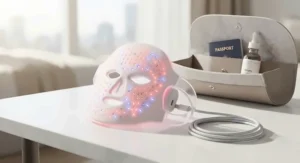
LED Mask for Acne and Aging: Can One Device Do Both?
Adult acne doesn’t politely retire once fine lines arrive. Plenty of Canadians in their 30s and 40s deal with both at once — which is exactly why the LED mask for acne and aging category has exploded.
What “both” really requires
A true LED mask for acne and aging needs at least two light channels — blue for breakouts and red (ideally plus near-infrared) for aging — and a way to choose between them or run them together. In this lineup, four masks qualify: the Dr. Dennis Gross DRx SpectraLite FaceWare Pro, Shark CryoGlow, Therabody TheraFace Mask Glo, and RENPHO Artemis LED Mask.
How to run a dual routine
The simplest approach is to split the week. For example:
- Monday, Wednesday, Friday: red + near-infrared for aging
- Tuesday, Thursday: blue (or blue + NIR) during active breakouts
- Weekend: combo mode or a rest day
Masks with preset programs make this easier. The Shark CryoGlow labels its modes by goal (Better Aging, Blemish Repair), while the RENPHO Artemis LED Mask lets you dial intensity down on days your skin feels reactive.
The honest limits
An LED mask for acne and aging works best on mild to moderate concerns. Cystic or hormonal acne usually needs a dermatologist and prescription treatment; light can support that plan, not replace it. Likewise, deep static wrinkles respond far better to retinoids, injectables, or in-clinic procedures. Treat the mask as the steady background player in a bigger routine.
Practical Usage Guide: Your First 30 Days
Buying the mask is the easy part. The first month is where most people either build a habit or shove the device into a drawer next to the forgotten jade roller. 🧊
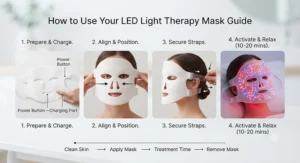
Setup (Day 1)
- Charge fully before first use. The CurrentBody Skin LED Mask Series 2 needs about 4.5 hours, so charge it overnight.
- Adjust the straps so the mask sits close to your skin without pressing. Gaps reduce the light that actually reaches you.
- Read the eye-protection guidance. Some masks include goggles or eye inserts; if yours doesn’t, close your eyes during sessions.
Your routine (Days 1-30)
- ✅ Cleanse first. Makeup, sunscreen, and heavy creams can block or scatter light. Use it on clean, dry skin.
- ✅ Apply serums after, not before — unless your brand specifically recommends a light-compatible gel.
- ✅ Anchor it to an existing habit. Ten minutes while your coffee brews, or three minutes with the Dr. Dennis Gross DRx SpectraLite FaceWare Pro while you brush your teeth.
- ✅ Take a weekly photo in the same light. Changes are gradual enough that you’ll miss them otherwise.
Maintenance schedule
- After every session: wipe the inner surface with a soft cloth and mild, alcohol-free cleanser.
- Weekly: check straps and cables for wear.
- Monthly: inspect LEDs for any dead diodes and clean charging ports.
Common first-month mistakes
- ❌ Doubling session length hoping for faster results — more isn’t better.
- ❌ Using it after a chemical peel or retinoid-irritated day without checking tolerance.
- ❌ Giving up at week three, right before most users report visible change.
Real-World Scenarios: Matching the Mask to the Face
Specs make more sense when you attach them to real lives. Here are three common buyer profiles and the reasoning behind each match.
Profile 1: The busy Toronto commuter with adult acne
Budget: around C$600. Environment: condo, early starts, long TTC commute. Frequency: realistically five mornings a week, if it’s fast.
Best match: the Dr. Dennis Gross DRx SpectraLite FaceWare Pro. The three-minute sessions fit into a rushed morning, and the red/blue combination addresses breakouts and early fine lines together. The cord doesn’t matter much when you’re standing at the bathroom sink anyway.
Profile 2: The retiree in Kelowna focused on firmness
Budget: flexible. Environment: a quiet evening routine. Frequency: four or five evenings per week, no problem.
Best match: the CurrentBody Skin LED Mask Series 2. With time to spare, the 10-minute session isn’t a burden, and the three-wavelength stack — including 1072 nm deep NIR — targets the aging concerns that matter most here. There’s no acne to treat, so a blue channel would be wasted money. The Omnilux Contour Face is a close alternative if a slightly lower price matters.
Profile 3: The university student in Halifax on a budget
Budget: under C$300. Environment: shared residence, limited counter space. Frequency: inconsistent — exams happen.
Best match: the RENPHO Artemis LED Mask. It covers red, blue, and near-infrared at the lowest cost, the flexible body stores easily, and adjustable intensity helps stressed, reactive skin. If the habit sticks, it’s a great device; if it doesn’t, the financial sting is much smaller than with a premium mask.
How to Choose an LED Light Therapy Mask
Choosing an LED light therapy mask gets much easier once you ignore the glossy lifestyle photos and focus on seven questions.
- Define your main concern. Aging points you to red + near-infrared; acne points you to blue; both points you to a dual-colour mask. This single decision eliminates half the market.
- Check the published wavelengths. Look for specific numbers (for example, 633 nm, 830 nm, 415 nm). A listing that only says “red light” is hiding something or doesn’t know.
- Look for regulatory status. FDA clearance is common; Health Canada authorization is rarer and more relevant to you. It signals the device has passed Canadian medical device requirements.
- Prioritise fit over LED count. A flexible mask with 132 LEDs sitting flush on your skin can outperform a rigid shell with more LEDs and visible gaps.
- Be realistic about session length. Three minutes, ten minutes, or twenty — pick the one you’ll actually do five days a week for three months.
- Compare warranties and return windows. Two years is the gold standard; a 30-day return window lets you test comfort.
- Consider power and portability. Cordless masks are freeing; wired controllers often last longer between charges.
Features that actually matter (and those that don’t)
Matter: published wavelengths, near-infrared inclusion, fit, warranty, and regulatory status.
Matter less than you’d think: the raw LED count headline, app connectivity, and dozens of colour modes. Yellow, green, and purple settings on cheap masks have far thinner evidence than red, near-infrared, and blue. A focused LED light therapy mask with the right three colours beats a rainbow of marketing modes every time.
LED Light Therapy Mask vs Other At-Home Skincare Devices
The at-home beauty shelf is crowded. Microcurrent wands, radio-frequency devices, dermarollers, sonic cleansing brushes — all competing for the same bathroom drawer and budget. So where does an LED light therapy mask fit among other at-home skincare devices?
| Device Type | Main Benefit | Session | Learning Curve | Downtime | Best For |
|---|---|---|---|---|---|
| LED light therapy mask | Tone, texture, acne, fine lines | 3-20 min | Very low | None | Hands-free, low-risk routines |
| Microcurrent device | Temporary lift and contour | 5-20 min | Moderate | None | Jawline and brow definition |
| Radio-frequency device | Tightening via gentle heat | 10-20 min | Moderate | Minimal | Early laxity |
| Microneedling roller | Texture and scarring | 5-10 min | High | 1-3 days redness | Acne scars (with care) |
| Sonic cleansing brush | Deeper cleansing | 1-2 min | Very low | None | Congested pores |
The standout advantage of LED is that it’s almost entirely passive — you put it on and you’re done, with no technique to master and no downtime. Microcurrent and radio-frequency tools can deliver more visible short-term lift, but they need correct technique, conductive gels, and several passes per session. Microneedling has the most potential for texture change but also the highest risk of irritation and infection if done wrong at home.
Can you combine at-home skincare devices?
Yes, and many people do. A common stack pairs a cleansing brush in the morning with an LED session in the evening, or alternates LED with microcurrent on different days. The key rule with at-home skincare devices is not to overload one session: combining heat-based radio frequency, active retinoids, and LED on the same night can leave sensitive skin irritated. Space them out and introduce one new tool at a time so you know what’s working.
🌟 Ready to build a routine that fits your life?
Click any highlighted mask above to check current pricing and availability on amazon.ca — the right device turns ten quiet minutes into a glow you’ll notice by spring!
Long-Term Cost & Maintenance
The sticker price of an LED light therapy mask feels steep until you divide it across real use. That’s where the value picture changes.
| Mask | Approx. Price (CAD) | Sessions/Year (4/week) | Cost per Session, Year 1 | Cost per Session, 3 Years | Best For |
|---|---|---|---|---|---|
| RENPHO Artemis LED Mask | ~C$250 | ~208 | ~C$1.20 | ~C$0.40 | Lowest entry cost |
| Kandyway Red Light Therapy Mask | ~C$475 | ~208 | ~C$2.30 | ~C$0.75 | Licensed value |
| Omnilux Contour Face | ~C$550 | ~208 | ~C$2.65 | ~C$0.90 | Clinical pedigree |
| CurrentBody Skin LED Mask Series 2 | ~C$650 | ~208 | ~C$3.10 | ~C$1.05 | Premium longevity |
These figures are illustrative, based on midpoints of the price ranges at the time of research. Even the priciest mask falls to roughly a dollar per session over three years — a fraction of an in-clinic LED facial, which commonly costs far more per visit. The real risk isn’t the price; it’s buying a C$650 device and using it twice.
Hidden costs to budget for
- Replacement straps or eye inserts — occasional, inexpensive.
- Battery wear — lithium batteries gradually lose capacity. A mask like the Therabody TheraFace Mask Glo, with roughly 60 minutes per charge, will feel battery ageing sooner than one with a month-long charge.
- Out-of-warranty failure — the main reason a two-year warranty matters.
Maintenance that extends lifespan
Store the mask flat or in its case, away from bathroom humidity where possible. Avoid harsh alcohol wipes on silicone, which can cause cracking over time. Unplug once fully charged rather than leaving it on the charger for days.
Safety, Health Canada & Who Should Skip Light Therapy
LED masks have a good safety profile compared with most beauty devices, but “low risk” isn’t “no risk.” A few guardrails make a big difference.
Understand Canadian regulation
In Canada, devices making therapeutic claims are regulated as medical devices, and Health Canada’s medical devices framework explains how products are classified and licensed. A licensed device has been reviewed against safety and effectiveness requirements for its class. That’s why the Kandyway Red Light Therapy Mask‘s authorization claim stands out: it’s verifiable, not just a marketing badge. FDA clearance, which most other masks carry, is meaningful too, but it’s a U.S. process.
Eye safety
Bright LEDs — especially blue — can be uncomfortable or potentially harmful to the eyes with repeated exposure. Always use the included eye protection, or keep your eyes closed if none is provided.
Who should check with a doctor first
- ⚠️ Anyone taking photosensitising medications (some acne treatments, certain antibiotics)
- ⚠️ People with epilepsy or light-triggered migraines
- ⚠️ Those with a history of skin cancer or active suspicious lesions
- ⚠️ People with lupus or other photosensitive conditions
- ⚠️ Anyone who is pregnant — evidence is limited, so caution is sensible
Signs to stop
Persistent redness, a burning sensation, headaches, or eye strain are signals to pause and consult a professional. Mild warmth is normal; pain isn’t.
Common Mistakes When Buying an LED Light Therapy Mask
A few predictable errors trip up first-time buyers. Avoid these and you’re already ahead of most of the market.
1. Buying the cheapest mask with no published specs
Ultra-cheap marketplace masks often list no wavelengths, no irradiance, and no regulatory status. You can’t evaluate what you can’t measure. If you want budget, choose one with disclosed specs like the RENPHO Artemis LED Mask rather than a mystery device.
2. Paying for colours you don’t need
If you have no acne, a blue channel adds cost without benefit. If you have no concern about aging, a deep NIR stack isn’t necessary. Match the colours to the problem.
3. Ignoring fit and weight
A 600 g rigid mask pressing on your nose every day becomes a reason to skip sessions. Comfort predicts consistency, and consistency predicts results.
4. Expecting results in a week
Most users and most studies measure change over 4-12 weeks. Buying with a one-week expectation almost guarantees disappointment.
5. Forgetting the return window
Keep the packaging for the first 30 days. If the fit is wrong, a clean return is far better than an expensive drawer ornament.
6. Skipping the basics
No LED light therapy mask outperforms daily sunscreen. Canadian UV is strong in summer and reflects off snow in winter — protecting skin you’re paying to improve is the cheapest upgrade available.
FAQ
❓ Is an LED light therapy mask worth buying in Canada?
❓ Where can I buy a Health Canada approved LED face mask?
❓ How long does an LED mask last before it needs replacing?
❓ Can I use an LED face mask every day?
❓ Which LED mask is best for sensitive skin?
Conclusion
An LED light therapy mask won’t rewrite your face overnight, but used consistently it can deliver quieter, meaningful changes — calmer breakouts, smoother texture, and softer fine lines — without downtime or a clinic appointment. The key is matching the device to your skin, your budget, and, most importantly, your schedule.
If you want the most complete anti-aging stack, the CurrentBody Skin LED Mask Series 2 is the benchmark. For proven clinical heritage, the Omnilux Contour Face is hard to fault. Pressed for time with acne and aging? The Dr. Dennis Gross DRx SpectraLite FaceWare Pro makes three-minute routines realistic. Puffy mornings point to the Shark CryoGlow, while the Therabody TheraFace Mask Glo leads on density. Canadians who value licensing should look closely at the Kandyway Red Light Therapy Mask, and anyone testing the waters will find the RENPHO Artemis LED Mask a remarkably capable start.
Remember the red vs blue light rule, pair your device with sunscreen and a sensible routine, and give it a full twelve weeks before judging. That’s the difference between a gadget and a genuine upgrade.
Recommended for You
- Peeling Gel vs Face Scrub For Beginners: 7 Picks Ranked (2026)
- AHA vs BHA Exfoliator For Acne-Prone Skin: 7 Picks (2026)
- 7 Best Enzyme Exfoliators for Sensitive Skin in Canada (2026)
Disclaimer: This article contains affiliate links. As an Amazon Associate, I earn from qualifying purchases. If you purchase products through these links, we may earn a small commission at no additional cost to you.
✨ Found this helpful? Share it with your friends! 💬🤗
